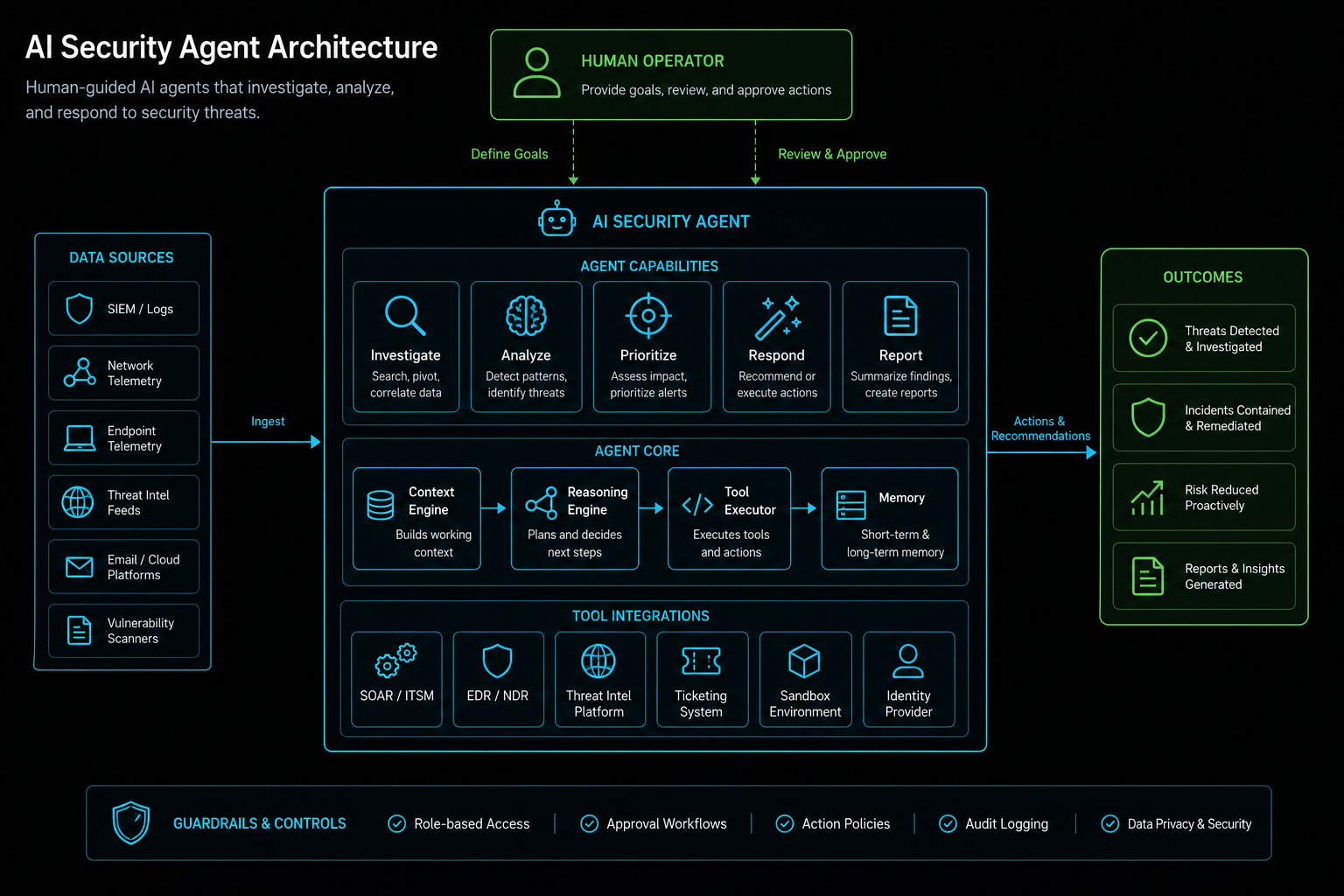
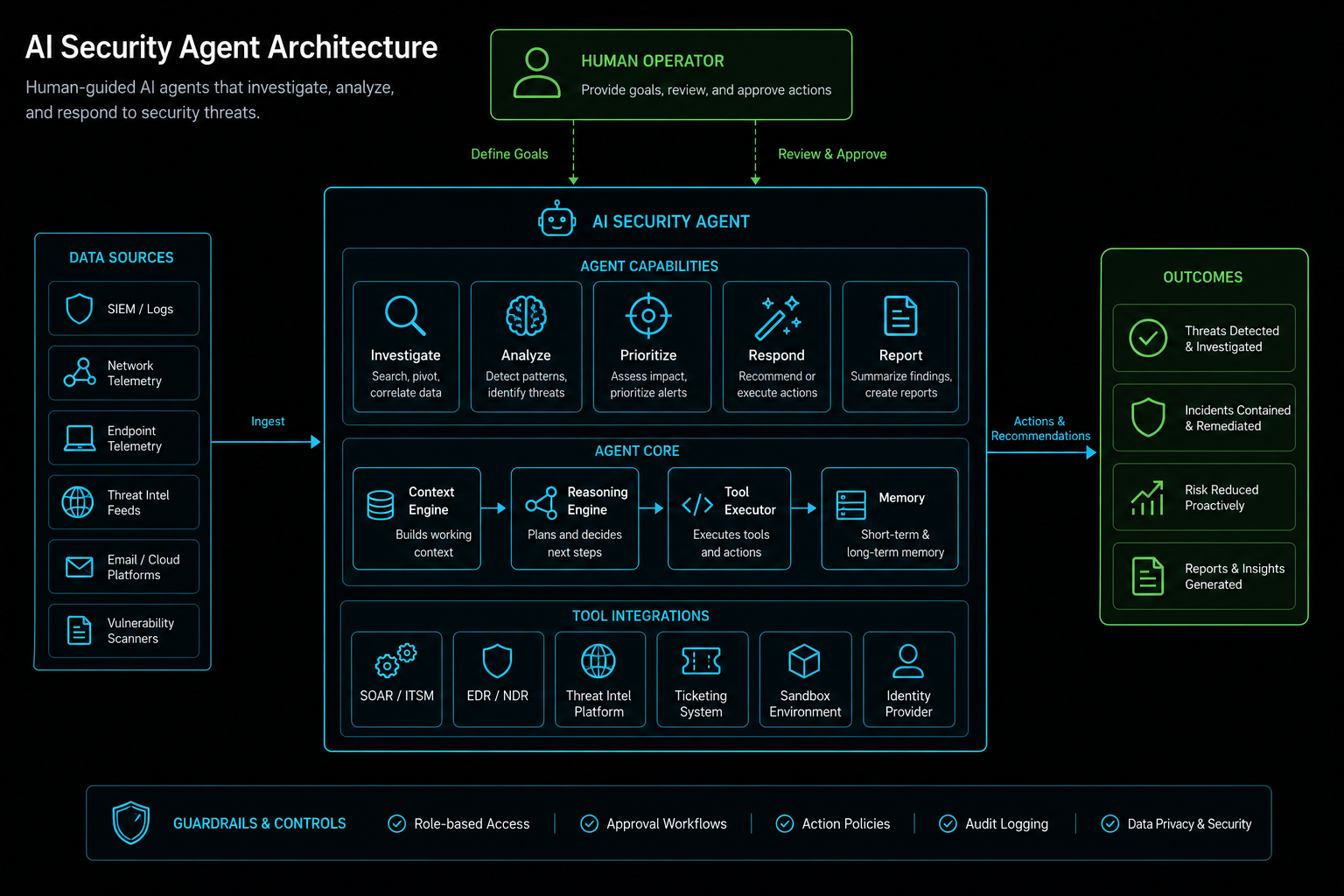
The core of this guide focuses on the Verification Loop and repeatable audit workflows. Below is a wider view of how a security agent can fit into a larger system — including data sources, capabilities, tool integrations, guardrails, and outcomes.
- 1.Context — Why Agents Change the Game
- 2.The Production Model: A Real 5-Phase Workflow
- 3.Core Concepts
- 4.Internal Security Operations
- 5.External Auditing & Consulting
- 6.Tangible Artifact: 5-Phase Checklist
- 7.Practical Re-Entry Ramp
- 8.Critical Pitfalls
- 9.Credible Public References
- 10.Further Watching
- 11.Next Steps
1. Context — Why Agents Change the Game #
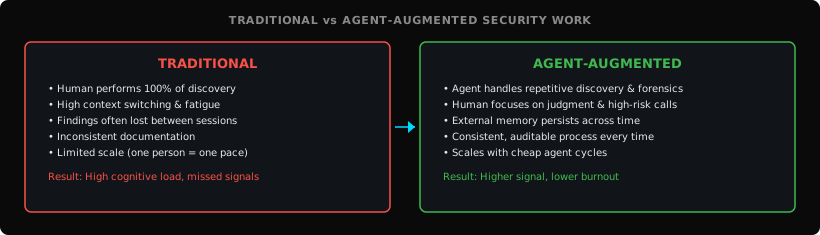
Security work has always been constrained by attention and memory. Agents change the economics: they can maintain perfect recall of baselines, run continuous checks, and handle the repetitive forensic work that humans naturally deprioritize.
The highest-leverage skill for a returning practitioner is no longer “know every CVE” but the ability to design, wire, and rigorously verify agent workflows that scale your existing expertise without introducing new blind spots.
2. The Production Model: A Real 5-Phase Workflow #
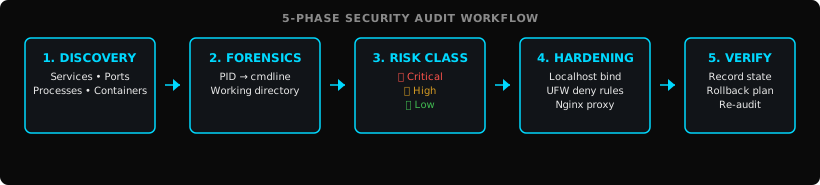
Effective security agents follow a disciplined, repeatable process rather than vague “scan everything” prompts. The strongest patterns observed in production use a structured five-phase approach.
Phase 1 — Discovery
Systematically inventory running services, listening ports, containers, scheduled tasks, and processes. Use raw command output (never trust agent summaries alone).
Phase 2 — Forensics & Mapping
For every listener or exposed process, trace the actual executable and working directory using process-level inspection. This step surfaces the majority of “unknown unknowns.”
Phase 3 — Risk Classification
| Risk | Criteria | Examples |
|---|---|---|
| 🔴 Critical | No authentication, no TLS, unknown or unexpected process directly internet-facing | Bare HTTP servers, forgotten debug endpoints, exposed databases |
| 🟠 High | Known service but missing auth/TLS or overly permissive exposure | APIs with wildcard CORS, monitoring endpoints on public interfaces |
| 🟡 Medium | Behind proxy but lacking rate limiting, logging, or recent restarts | Internal apps with weak configuration exposed through a gateway |
| 🟢 Low | Localhost-only, strong controls, properly documented | Databases bound to 127.0.0.1 behind nginx with mTLS |
Phase 4 — Hardening (in strict priority order)
- Bind to localhost where possible
- Add firewall deny rules as a safety net
- Place behind a reverse proxy with proper TLS and access controls only when public access is required
Phase 5 — Documentation & Verification
Record the before/after state, exact commands used, and rollback procedures. Re-verify with independent commands after changes.
The key discipline: agents propose and document. Humans (or dual-control processes) execute on anything that changes listening ports, authentication, or data access.
3. Core Concepts #
Three principles separate useful security agents from dangerous ones:
- Memory outside the model — Baselines, previous findings, and runbooks must live in structured, queryable storage that survives model changes and context resets.
- Specialization over generality — One agent that does continuous posture monitoring is more reliable than a general “security agent.”
- Verification as a first-class loop — Every material claim (especially “nothing exposed”) must be independently validated with raw system commands before being trusted.
4. Internal Security Operations #
Agents excel at the work humans tend to deprioritize over time:
- Continuous baseline drift detection against last-known-good snapshots
- Regular secret and credential hygiene scanning
- Log correlation and anomaly flagging for human review
- Scheduled deep configuration audits with clear remediation steps
5. External Auditing & Consulting #
The same disciplined workflow becomes a product when delivered to clients. The combination of consistent methodology + transparent evidence + human oversight creates a defensible offering that pure automated scanners cannot match and pure manual work cannot scale.
6. Tangible Artifact: 5-Phase Security Audit Checklist #
Copy this checklist and adapt it
### Security Audit Checklist (5-Phase)

**1. Discovery**
- [ ] systemctl list-units --type=service --state=running
- [ ] ss -tlnp (all listening ports + PIDs)
- [ ] docker ps --format "table {{.Names}}\t{{.Ports}}"
- [ ] crontab -l + /etc/cron.* + systemd timers

**2. Forensics & Mapping**
- [ ] For each non-localhost listener: cat /proc/[PID]/cmdline
- [ ] Record working directory and parent process
- [ ] Identify systemd unit or container name

**3. Risk Classification**
- [ ] Apply Critical / High / Medium / Low rubric
- [ ] Flag any Critical or High items immediately

**4. Hardening (in order)**
- [ ] Bind services to 127.0.0.1 where possible
- [ ] Add UFW/iptables deny rules for exposed ports
- [ ] Move required public services behind nginx + TLS

**5. Documentation & Verification**
- [ ] Record before/after state with exact commands
- [ ] Document rollback steps for every change
- [ ] Re-run key discovery commands after changes
- [ ] Store findings with date and responsible party
7. Practical Re-Entry Ramp #
Week 1: Build your personal memory layer (quick reference baselines + findings log). Run a full manual discovery on your own systems.
Week 2: Implement the 5-phase workflow as your first agent skill or script. Force-compare every finding against manual verification.
Week 3: Add mandatory verification gates and schedule the first recurring run with human review of output.
Week 4–6: Apply the workflow to a real (or simulated client) environment. Package the checklist + evidence template as a repeatable deliverable.
8. Critical Pitfalls #
- Trusting agent summaries instead of raw command output
- Skipping the forensics mapping step (the most common source of hidden exposures)
- Allowing agents to make changes without pre-written rollback procedures
- Building generalist agents instead of narrow, well-scoped ones
- Ignoring the need for persistent external memory
9. Credible Public References #
The patterns in this guide are informed by the following high-quality public frameworks and research (as of 2026):
- OWASP Top 10 for Agentic Applications (2026) — The leading industry framework for risks specific to autonomous, tool-using, memory-equipped AI agents. Covers goal hijacking, tool misuse, identity abuse, supply chain issues, memory poisoning, and rogue agents. Official resource
- Cloud Security Alliance – Agentic AI Red Teaming Guide (May 2025) — Practical 62-page playbook with 12 threat categories and a structured red teaming methodology tailored to agentic systems. Includes MAESTRO threat modeling framework. CSA Resource
- NIST Cybersecurity Framework Profile for Artificial Intelligence (IR 8596, draft Dec 2025) — Extends CSF 2.0 with specific guidance on using AI (including agents) defensively while defending against agentic attacks. Strong on governance, detection, and response. NIST Draft
- Berkeley CLTC – Agentic AI Risk-Management Standards Profile (2026) — Maps agent-specific risks and controls directly to the NIST AI Risk Management Framework. Excellent bridge document for practitioners.
These are the current authoritative public references for anyone building or using agents in security contexts.
10. Further Watching #
11. Next Steps #
Start with the checklist in this guide. Run it manually on a system you control, then gradually add agent assistance with strong verification loops.
Related guides on this site that pair well with this one:
- Ten Services, One VPS — Hardening and operational patterns that complement agent-driven auditing.
- Claude Code Skills: An Anatomy — How to structure repeatable, high-quality agent capabilities.
- The Agent File Pattern — Architectural thinking for building reliable, maintainable agents.
Security work with agents is still early. The advantage goes to practitioners who combine deep domain knowledge with rigorous verification and external memory — not those who trust the model the most.